
The Only Guide You Need to Understand RPL Kits in VET Sector
Recognition of Prior Learning (RPL) is one of the most valuable pathways in the Australian VET sector. It gives learners a chance to convert existing skills and workplace experience into nationally recognised outcomes – often faster than traditional study. However, for RTOs and assessors, RPL can quickly become complex without the right tools. That’s where RPL kits come in.
In this guide, you’ll learn what RPL kits are, how they work, what a quality kit should include, and how they help RTOs deliver consistent, compliant assessments.
What Is an RPL Kit?
An RPL kit is a structured set of documents and tools that supports assessors and candidates through the RPL process. In other words, it’s a ready-to-use framework designed to help gather, map, and assess evidence against unit requirements.
Rather than starting from scratch for every candidate, RPL kits provide a consistent method to:
- Identify relevant workplace evidence
- guide candidates on what to submit
- support assessors to make valid and reliable judgements
- Align the process with the training package and compliance expectations
As a result, RPL becomes clearer for students and far more efficient for the RTO.
Why RPL Kits Matter in the VET Sector
RPL is not simply “giving credit for experience.” It must be assessed properly, using evidence that demonstrates competency. That’s why quality RPL kits are essential.
Consistency across assessors and cohorts
When multiple trainers or assessors are involved, RPL decisions may vary if each uses different tools. A well-built kit ensures consistent evidence standards are applied across all candidates.
Better candidate experience
Candidates often feel unsure about what evidence is “good enough.” With clear instructions, examples, and templates, they can submit evidence confidently and avoid unnecessary back-and-forth.
Stronger compliance and audit readiness
Most importantly, RPL must stand up to scrutiny. RPL kits document the process properly, allowing the RTO to show how it made decisions and what evidence supported competency.
How RPL Kits Support Valid Assessment Decisions
To make a valid RPL decision, an assessor must confirm the candidate has met competency requirements—not just worked in the industry. Therefore, evidence must clearly demonstrate the required skills and knowledge.
A quality RPL kit helps assessors by:
- prompting the right evidence for each unit
- encouraging third-party verification where needed
- structuring conversations and challenging questions
- Guiding candidates to complete gap training or provide additional evidence when competency isn’t fully demonstrated.
In short, RPL kits bridge the gap between “experience” and “competence.”
How Does RPL Differ From Other Forms Of Assessment
Recognition of Prior Learning (RPL) is a unique form of assessment that differs from other forms of assessment in several ways. Here are some of the key differences:
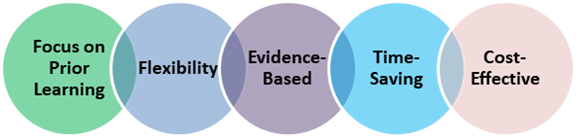
- Focus on Prior Learning: RPL is primarily concerned with assessing an individual’s prior learning and experience, rather than their current knowledge or skills. This means that RPL assessors will look at a candidate’s past experiences, qualifications, and work history to determine if they meet the requirements for a particular qualification.
- Flexibility: RPL offers a flexible form of assessment that tailors to the individual needs of the candidate. This allows candidates to choose an assessment method that suits their learning style and preferences.
- Evidence-Based: RPL is an evidence-based form of assessment, which means that candidates need to provide evidence of their prior learning and experience. This evidence can take many forms, such as certificates, work samples, or testimonials from previous employers.
- Time-Saving: RPL is often faster than other forms of assessment because it doesn’t require candidates to complete a full course or qualification. Instead, RPL assessors will focus on the areas where the candidate needs to demonstrate competence.
- Cost-Effective: RPL can be a cost-effective way for candidates to qualify because they only need to pay for the assessment process, rather than the full course or qualification.
Overall, RPL is a valuable form of assessment that can help individuals to gain recognition for their prior learning and experience. It is a flexible, evidence-based, and cost-effective way to achieve a qualification in the VET sector.
How to Develop an RPL Kit
Creating an RPL kit may seem overwhelming, but with proper guidance, it can be accomplished efficiently. An RPL kit serves as a comprehensive document that assists assessors throughout the RPL (Recognition of Prior Learning) procedure. Typically, it includes essential details such as an overview of RPL, the step-by-step process, units of competence requirements, assessor responsibilities, student expectations, assessment plan and tools, evidence collection methods, and the outcome of the RPL assessment.
To develop an RPL kit, follow these steps:
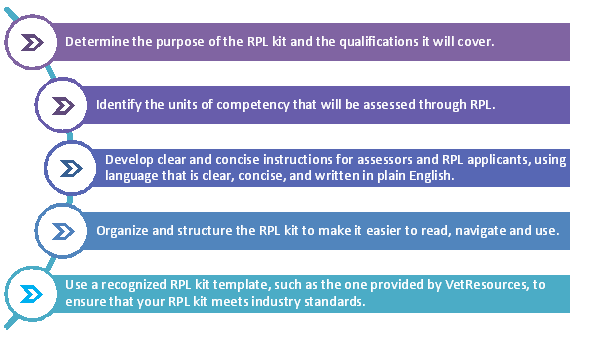
- Determine the purpose of the RPL kit and the qualifications it will cover.
- Identify the units of competency that will be assessed through RPL.
- Develop clear and concise instructions for assessors and RPL applicants, using language that is clear, concise, and written in plain English.
- Organise and structure the RPL kit to make it easier to read, navigate and use.
- Use a recognised RPL kit template, such as the one provided by Vet Resources, to ensure that your RPL kit meets industry standards.
By following these steps, you can develop an effective RPL kit that will guide assessors and RPL applicants through the RPL process with ease.
How To Conduct RPL Assessment

Recognition of Prior Learning (RPL) is a process of assessing the skills, knowledge and experience that a person has gained through work experience, training, volunteering or other activities. It is an important process in the Vocational Education and Training (VET) sector as it provides individuals with the opportunity to have their existing skills and knowledge recognised, which can lead to the attainment of a nationally recognised qualification.
To conduct an RPL assessment, there are several steps that need to be followed. These include:
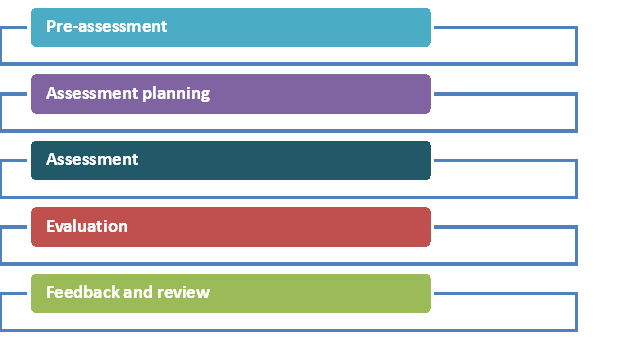
- Pre-assessment: Before conducting an RPL assessment, the assessor needs to gather information about the candidate’s skills, knowledge and experience. You can do this through a variety of methods, such as interviews, questionnaires, and observation.
- Assessment planning: Based on the information gathered during the pre-assessment stage, the assessor needs to plan the assessment process. This includes identifying the evidence required to demonstrate the candidate’s skills and knowledge, and developing assessment tools and methods.
- Assessment: The assessment process involves collecting evidence to demonstrate the candidate’s skills and knowledge. This can be done through a variety of methods, such as observation, questioning, and reviewing work samples.
- Evaluation: Once the evidence has been collected, the assessor needs to evaluate it against the relevant competency standards. This involves making a judgment about whether the evidence provided is sufficient to demonstrate competence.
- Feedback and review: After completing the assessment, the assessor provides feedback to the candidate on their performance. The candidate also has the right to request a review of the assessment decision if they are not satisfied with the outcome.
In conclusion, conducting an RPL assessment is a complex process that requires careful planning, assessment, evaluation and feedback. However, when done correctly, it can provide individuals with the opportunity to have their existing skills and knowledge recognised, which can lead to the attainment of a nationally recognised qualification and ultimately, better employment opportunities.
Common Mistakes RTOs Make with RPL (And How to Avoid Them)
Even experienced RTOs can run into trouble if RPL is rushed or poorly documented. Here are common pitfalls—and how a strong kit prevents them.
Accepting evidence that isn’t mapped
If evidence isn’t clearly linked to unit requirements, it’s difficult to justify the outcome. Kits reduce this risk by including mapping tools and benchmarks.
Relying only on self-assessment
Self-assessment can support the process, but it should never be the only evidence. Kits should prompt multiple evidence types and third-party confirmation.
Lack of consistency between assessors
Without shared tools, assessors may interpret evidence differently. Standardised kits promote consistency and reduce compliance risk.
Who Should Use RPL Kits?
RPL kits are useful across the VET sector, particularly for:
- RTO owners and compliance managers, aiming to strengthen audit readiness
- Assessors and trainers who need structured, time-saving tools
- Students and workers who need clarity on the evidence required.
- CRICOS providers where consistency and documentation are especially important
Additionally, RPL kits are valuable for high-volume qualifications where multiple candidates apply for RPL each intake.
Conclusion
At VET Resources, we provide comprehensive RPL kits for various training packages, including BSB, ICT, UEE, CHC, CPC, and more. Our RPL kits simplify the RPL process for trainers and students, ensuring consistent, quality assessment decisions.
Our kits include essential tools such as RPL assessment plans, tools, and candidate guides, designed to gather evidence of skills and knowledge. They align with current industry standards and regulatory requirements, ensuring up-to-date and relevant assessments.
RPL is a valuable pathway for those with prior experience. With VET Resources, trainers and students can navigate RPL seamlessly, ensuring accurate and reliable assessments every time.
FAQs:
1) What is an RPL kit in the VET sector?
An RPL (Recognition of Prior Learning) kit is a set of resources used by Registered Training Organisations (RTOs) to assess learners’ skills and knowledge gained through work or life experience, without formal training.
2) How do RPL kits benefit RTOs?
RPL kits help RTOs streamline the assessment process, reduce training time for learners, and ensure compliance with ASQA standards. They also improve operational efficiency and enhance learner satisfaction.
3) What should an RPL kit include?
An RPL kit typically includes clear guidelines, assessment tools, evidence requirements, and supporting documentation to assess the learner’s prior knowledge and skills against a qualification’s competencies.
4) Who can use RPL kits in the VET sector?
RPL kits are used by RTO assessors, trainers, and administrators to evaluate learners’ prior learning. They can be used for learners with relevant industry experience or informal education seeking formal recognition.
5) How do I create an RPL kit for my RTO?
To create an RPL kit, align it with the specific training package, ensure it covers all required competencies, and include clear instructions for assessors. Work with industry experts to ensure the kit is relevant and comprehensive.
6) What are the key components of an effective RPL assessment process?
An effective RPL assessment process involves gathering evidence of the learner’s prior knowledge, mapping it to the required competencies, conducting assessments fairly and consistently, and providing feedback to learners.
7) Can RPL kits be used for all qualifications in the VET sector?
Yes, RPL kits can be adapted for most qualifications in the VET sector. However, they need to be tailored to specific training packages and competencies to ensure they meet the requirements of each qualification.
8) How does RPL differ from traditional assessments in VET?
Unlike traditional assessments that focus on knowledge gained through formal education, RPL recognises prior skills and experiences, allowing learners to receive formal recognition for their existing competencies.
Disclaimer:
The information presented on the VET Resources blog is for general guidance only. While we strive for accuracy, we cannot guarantee the completeness or timeliness of the information. VET Resources is not responsible for any errors or omissions, or for the results obtained from the use of this information. Always consult a professional for advice tailored to your circumstances.